
PerfectScale
PerfectScale by DoiT: Summer Releases Recap
A recap of PerfectScale's summer releases: Karpenter and unevictable pod recommendations, GPU memory visibility, ephemeral workload grouping, new guardrails, an AI agent skill, and the InfraFit API.
This page is also available in Deutsch, Español, Français, Italiano, 日本語, and Português.


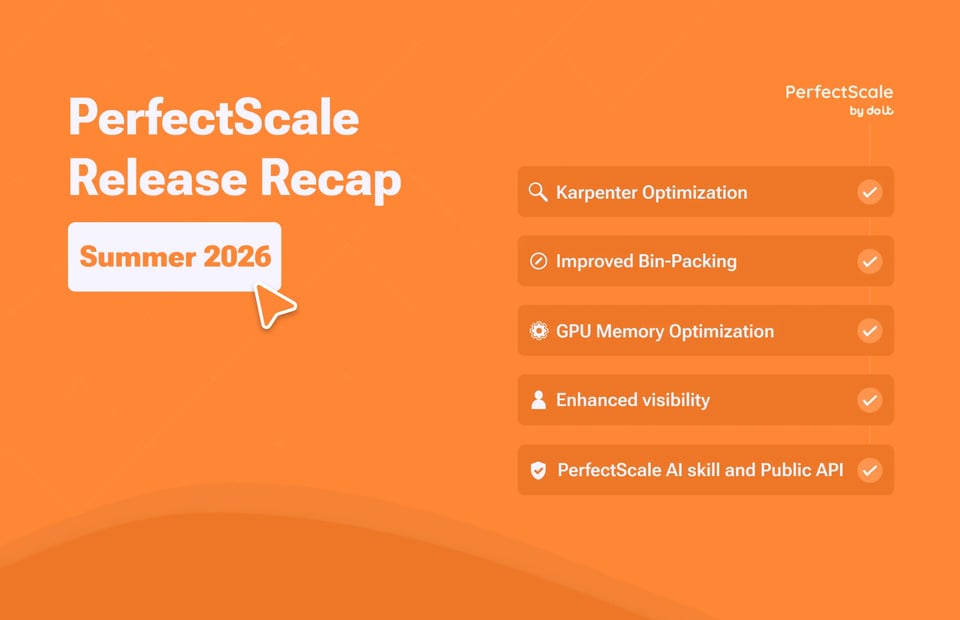
While your clusters kept scaling, we shipped plenty of big and small new capabilities and improvements to help you get better optimization results.
This recap covers some of the key things we’ve been working on, from infrastructure and GPU optimization to safety guardrails and making PerfectScale insights available outside of the platform.
Let’s get into it.
Turning infrastructure visibility into action
Node-level waste is a big part of the Kubernetes bill, and optimizing it with confidence isn’t trivial. This summer, we turned two visibility-level insights into clear, actionable recommendations.
Karpenter optimization recommendations
Karpenter is only as good as its NodePool configuration, and that configuration is usually set once, at launch, and rarely revisited. Meanwhile, workloads change: new services ship with different CPU-to-memory profiles, usage patterns shift, and instance families that made sense six months ago may now be overpriced or hard to source. The result is quiet waste: underutilized nodes, scheduling failures, and missed savings that only surface in a cloud bill or a spike in pending pods.
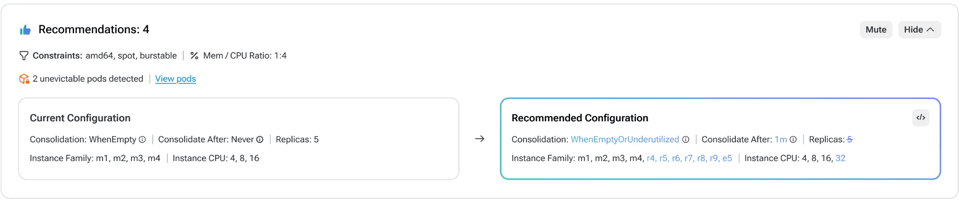
PerfectScale now delivers actionable Karpenter optimization recommendations, continuously evaluating your NodePool settings against actual workload behavior. It flags configuration that's too narrow, outdated, or misaligned, poor CPU-to-memory fit, limited instance selection, missed consolidation opportunities, and turns that into informed decisions: where to tighten consolidation, which instance categories fit better, and how to adjust NodePool limits.With this new capability, PerfectScale extends the optimization loop: right-sized workloads provide the foundation, Karpenter is configured based on real demand, and the infrastructure keeps adapting as demand changes.
Unevictable Pods recommendations
Back in spring, we shipped visibility into unevictable pods: workloads that get “stuck” on a node and block it from scaling down, quietly limiting your bin-packing efficiency. Visibility showed you where the blockers were. Now, we’re turning those insights into action.
PerfectScale now provides data-driven recommendations for the pods it flags as unevictable, so you can resolve scale-down blockers in a few clicks unlocking better node consolidations and bin-packing.
GPU optimization
GPUs already account for a large share of the cost of a GPU node, so underutilization and idle GPU capacity can quickly translate into significant wasted spend. PerfectScale already provided granular compute utilization and efficiency visibility, but that was only half the picture. Memory is where AI workloads can actually introduce operational difficulties: allocate too little and you risk OOMs, allocate too much “just in case”, and you end up paying for expensive capacity that has never been used.
PerfectScale now provides GPU memory visibility alongside GPU compute, giving you a clear view of how workloads actually use GPU memory. This means you can size AI workloads based on real usage instead of guesswork, avoiding unnecessary capacity while reducing the risk of memory-related performance issues.
Ephemeral workload grouping
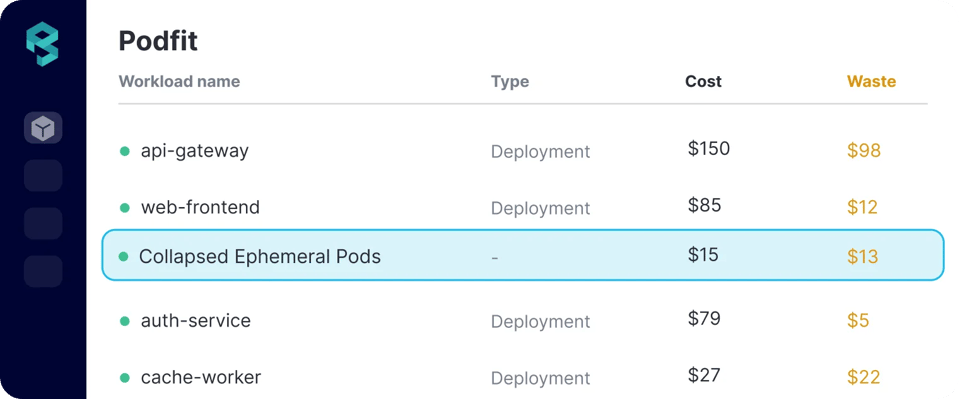
Spark jobs, Airflow DAGs, CI runners: these workloads don't live long enough for traditional right-sizing to build a reliable picture, and each short-lived pod shows up as its own noisy, disconnected data point.
Ephemeral workload grouping consolidates these short-lived workloads into a single entity, removing the noise from hundreds of one-off runs and giving users a clear view of what actually matters.
Guardrails that keep automation safe
Confidence in automation comes from knowing exactly what it will or will not do. This summer, we delivered two updates to make PerfectScale’s reliability-first approach even stronger.
CPU runaway detection
Not every CPU spike is a sizing problem. Some are symptoms of a bigger problem: a stuck retry loop, a bug that keeps a CPU core busy, and more. Left unchecked, these patterns can skew utilization data and lead automation to make the wrong decisions.
PerfectScale now detects CPU runaway behavior. This keeps sizing decisions safe and accurate and gives your team an early signal when something is actually wrong, not just busy.
Full-mode ResourceQuota support
ResourceQuota has always been one of PerfectScale's system-defined safeguards: automation and recommendations are capped so they never exceed a user-defined resource quota. Until now, this worked in decrease-only mode whenever a recommendation approached the limit.
With full-mode ResourceQuota support, PerfectScale now increases workload resources right up to the quota cap when a workload needs it, instead of stopping short. You still get the same hard ceiling and protection against quota violations, but now the full range below that ceiling is available to address real under-provisioning.
Extending PerfectScale beyond the UI
The last piece of the summer wasn’t about adding new insights. It was about making the insights you already have easier to access and use.
PerfectScale AI agent skill
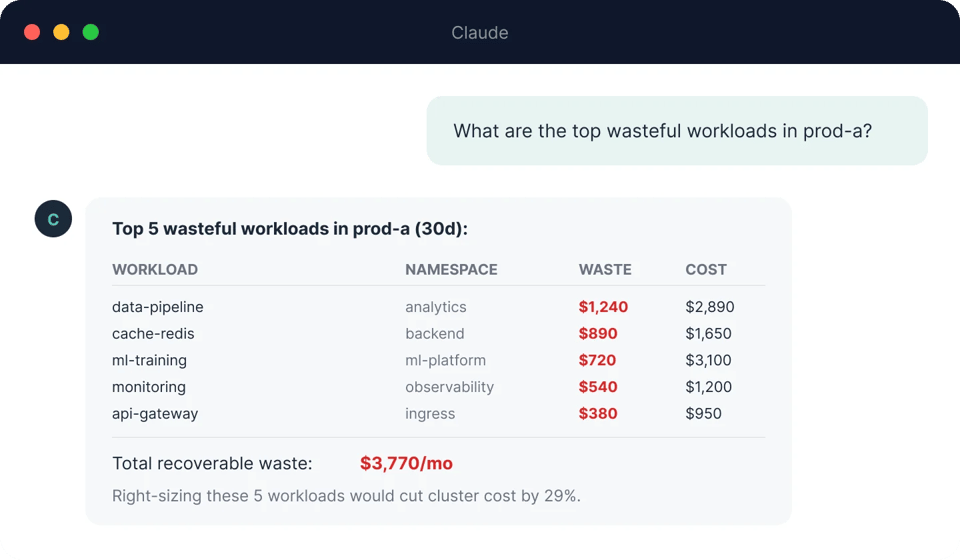
Kubernetes optimization data is only useful if it reaches you where you're already working, and for most teams that's no longer just a dashboard. The PerfectScale AI agent skill brings PerfectScale data into your agentic workflows, so you can use AI agents like Claude or Codex to query and filter data by cost, risk, namespace, and more. The CLI behind it is open source, outputs structured JSON/JSONL, and is designed to work alongside the other operational data your agents already use.
Infrafit public API
Node-level data has been available in the UI for a while. Now it's available programmatically. The InfraFit public API extends PerfectScale’s API surface to include node group and node type data, as well as Karpenter and bin-packing recommendations. Teams can pull infrastructure-level cost, waste, utilization, and optimization insights directly into their engineering workflows.
Wrapping up
Looking back at the summer, the pattern is clear: visibility became action, guardrails got stronger, and PerfectScale insights became easier to use where your team works.
It all comes back to the same optimization philosophy: Kubernetes optimization should be safe, data-driven, and actionable.
And we’re not done. More is coming!
📖 Find more details in our documentation.
🦸♀️ Hop on a call with our team if you'd like expert assistance.
Not using PerfectScale yet? Start for free today and simplify your K8s optimization journey.