
PerfectScale
Why Kubernetes Optimization Still Leaves Savings Behind
Kubernetes optimization may be working perfectly, and still leave savings on the table. PerfectScale aligns commitments and turns efficiency into real savings.
This page is also available in Deutsch, Español, Français, Italiano, 日本語, and Português.
Your DevOps team is focused on engineering excellence. You’re true masters of Kubernetes optimization - continuously and meticulously right-sizing all the container CPU and memory requests. You've set up vertical, horizontal, and node-level autoscaling. Your production is running without hiccups, and you’re reporting high CPU utilization and optimal binpacking. The cost of your Kubernetes clusters should shrink by at least 40%. But then - you get the cloud bill at the end of the month, and it hasn’t budged by a cent!
How is that possible? Welcome to the cloud financial trap: optimizing infrastructure without aligning your commitments.
The Fallacy of Infrastructure Optimization
In the world of cloud-native engineering, we are conditioned to believe that better resource utilization automatically equals lower costs. We focus heavily on two layers:
- Pod-Level Optimization: Right-sizing containers, cleaning up idle microservices, and managing memory leaks.
- Node-Level Optimization: Using cluster autoscalers, packing pods efficiently (bin-packing), and selecting the right instance types.
These are excellent engineering practices. But in a cloud environment, architecture and finance are deeply coupled. If you optimize the infrastructure layer but ignore the billing layer, you are simply paying the cloud provider to run absolutely nothing at maximum efficiency.
The Commitment Trap
Cloud providers (AWS, GCP, Azure) offer significant discounts, often up to 72%, if your organization commits to a certain amount of usage over a 1- or 3-year term.
These come in the form of Savings Plans, Reserved Instances (RIs), or Committed Use Discounts (CUDs).
But the harsh reality is: Commitments are a use-it-or-lose-it contract. (Especially if not managed carefully)
If you commit to paying for 100 units of compute, and your brilliant engineering optimization successfully drops your actual usage from 120 units down to 80 units, you don’t save money. You still pay for 100 units.
For example, you’ve committed to $100K/month, but optimization reduces actual usage from $120K to $80K - which means you don’t realize the full $40K savings. You still pay the $100K commitment, so only $20K becomes real savings, and $20K is wasted commitment. Meaning 50% of your engineering effort has gone to waste.
The Futility Formula:
> If $ActualUsage < $CommittedBaseline, then every hour spent optimizing pod utilization results in $0 in savings.
The result: you haven't saved the company money; you’ve just created "zombie commitments" - paid capacity that sits completely idle. And you’ve also wasted all that time on the optimization effort instead of building something more exciting.
Why FinOps and DevOps Must Merge
This disconnect happens because engineering teams and finance teams often operate in silos.
- FinOps looks at historical data and purchases a 3-year Savings Plan to lock in a low rate based on last year's massive, unoptimized footprint. They don’t use smart tools - relying on their spreadsheets and professional judgement.
- Engineering launches a Kubernetes optimization initiative to modernize the stack and reduce the footprint. Being engineers, they invest in automating this, so everything is optimized continuously.
- The Result: Engineering succeeds technically, but Finance is locked into a contract for capacity that no longer exists.
To prevent this, Kubernetes optimization must be a coordinated dance between technical rightsizing and financial commitment management.
Stop Guessing, Start Laddering: Meet PerfectScale for Commitments
To ensure your engineering efforts actually impact the bottom line, your technical rightsizing must act in perfect sync with your financial purchasing. Doing this manually using spreadsheets and rigid, multi-year forecasts is a recipe for overcommitment.
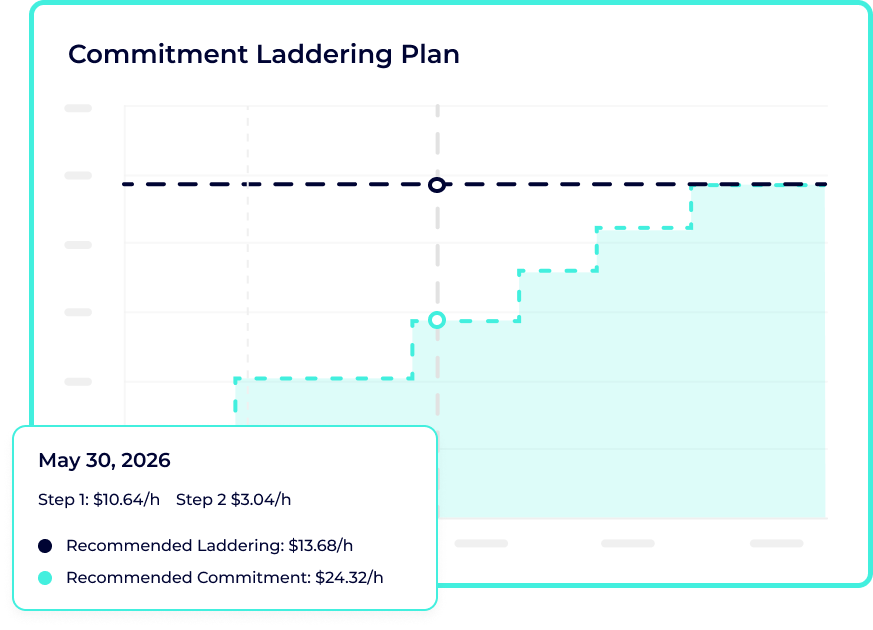
This is exactly why DoiT created PerfectScale for Commitments.
Instead of forcing you to make massive, upfront gambles on compute capacity, PerfectScale for Commitments introduces a risk-aware, automated approach designed to keep your savings and your infrastructure in lockstep:
- Smart Recommendations: Eliminate the guesswork - PerfectScale delivers spend-based commitment recommendations based on actual cloud usage trends and pre-defined risk buffer policies.
- Intelligent Laddering: Most commitment tools push you to buy everything upfront, leaving you locked into rigid baselines. PerfectScale staggers your purchases over time, validating every step against real-time patterns so you never cross the line into overcommitment.
- Unified Multi-Cloud Control: Stop jumping between cloud provider consoles. PerfectScale for Commitments allows you to manage AWS Savings Plans (including Database Savings Plans) and Google Cloud Committed Use Discounts (CUDs) from a single, structured dashboard.
- Controlled Automation & Guardrails: You maintain total control. Set exact risk tolerances, spend limits, and pacing controls. Choose between fully autonomous optimization or a hands-on approval workflow where the system generates purchase schedules for you to review before execution.
- Proven Savings Visibility: Track your Effective Savings Rate (ESR), coverage, and utilization in one unified view. You can instantly prove financial impact to leadership without spending hours manually assembling reports.
Conclusion: Efficiency Without Savings is Just Churn
Optimizing Kubernetes is hard work. It requires deep technical knowledge, rigorous testing, and a lot of patience. Even with smart tools like PerfectScale automation. Don't let that effort go to waste.
If your team is investing the effort in optimizing your pods and nodes, make sure they talk to the FinOps team first. By marrying your PerfectScale for Kubernetes optimization with PerfectScale for Commitments, you ensure that every pod right-sized and every node optimized actually reduces your monthly cloud bill.
Ready to eliminate the guesswork and capture real savings? Book a demo of PerfectScale for Commitments today.