
PerfectScale
Autonomous Optimization Across Your Entire Kubernetes Stack
PerfectScale now tunes Karpenter, removes bin-packing blockers, fixes HPA settings and reacts faster to OOM events, keeping Kubernetes efficient as it evolves.
This page is also available in Deutsch, Español, Français, Italiano, 日本語, and Português.

About Marie Jaksman
Senior Marketing Manager
Part growth marketer, part DevOps translator. Optimizing funnels and clusters with a healthy fear of wasted compute.
My personal pageAt KubeCon NA 2026 in Salt Lake City, PerfectScale is showing how to go beyond pod rightsizing and optimize the entire Kubernetes stack: from workloads and replicas to nodes. New capabilities include autonomous Karpenter tuning, active bin-packing improvement, HPA automation, and faster reactions to OOM events. All the capabilities work with your existing autoscalers, so you can improve efficiency without replacing the tools you already use.
Pod rightsizing is only part of the picture. Pod requests and limits define how much memory and compute workloads are reserved. Overall infrastructure efficiency also depends on how many replicas HPA runs, how Karpenter provisions and consolidates nodes, and how efficiently those nodes are packed.
These layers are closely connected. Rightsizing pods can deliver significant savings, but more opportunities remain when replica counts are too high, nodes are overprovisioned, or available capacity sits idle. PerfectScale now optimizes these layers together, helping teams get more from their existing Kubernetes infrastructure as demand changes.
The next step in Kubernetes optimization
Autoscaler settings are often configured once during setup or adjusted during an incident, then left unchanged. But workloads evolve, traffic patterns shift, and new, more cost-effective instance types become available. A configuration that made sense three months ago can now waste money or put reliability at risk. For example:
- Karpenter consolidation is too conservative, leaving idle capacity running and raising costs. Or it's too aggressive, risking instability.
- An unevictable pod blocks a node from being removed, even when the rest of the node is empty.
- HPA settings become outdated: a minimum replica value was raised during an incident and never lowered, or the scaling target no longer matches actual workload behavior.
New, more cost-effective instance types go unused, while Karpenter continues provisioning infrastructure that costs more than needed. A pod runs out of memory, and the default response is to increase memory for every replica.
Do any of these sound familiar in your Kubernetes infrastructure?
PerfectScale has always kept pod requests and limits aligned with actual workload needs. At KubeCon, we're showing how that same continuous optimization now extends to replicas, nodes, and memory reliability. By aligning these components as workloads and infrastructure change, PerfectScale helps teams reduce costs and maintain reliability within the policies and guardrails they define.
Autonomous Karpenter tuning
Karpenter is powerful, but only as good as its configuration. Most teams set it up once and expect it to figure things out as the environment evolves, while they get back to shipping and firefighting.
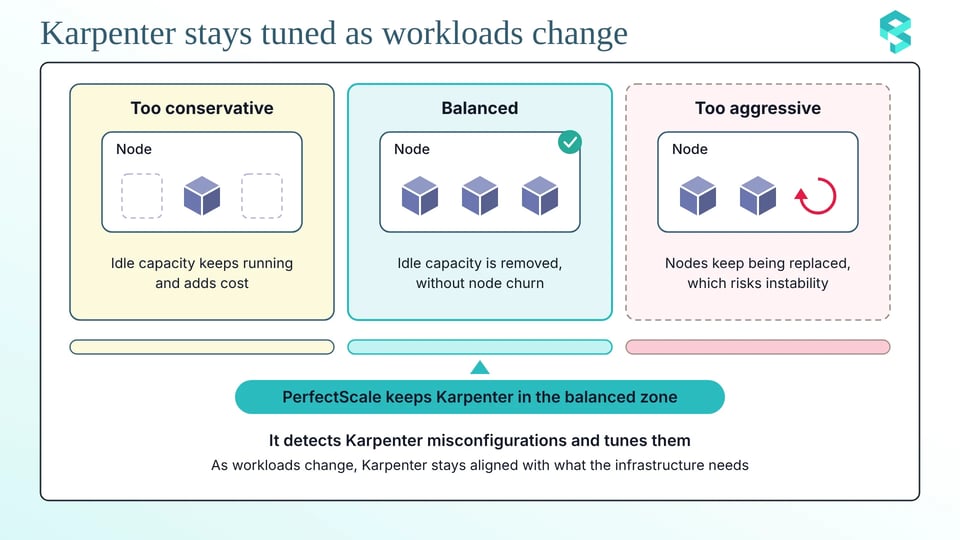
PerfectScale now continuously detects Karpenter misconfigurations and tunes them, so consolidation removes idle capacity without causing node churn. As workloads change, Karpenter stays aligned with your infrastructure needs, without constant manual tuning.
Active bin-packing
Sometimes a node is almost empty but can't be consolidated because one or more pods can't be evicted. That one pod keeps the entire node running, feeding your cloud bill.
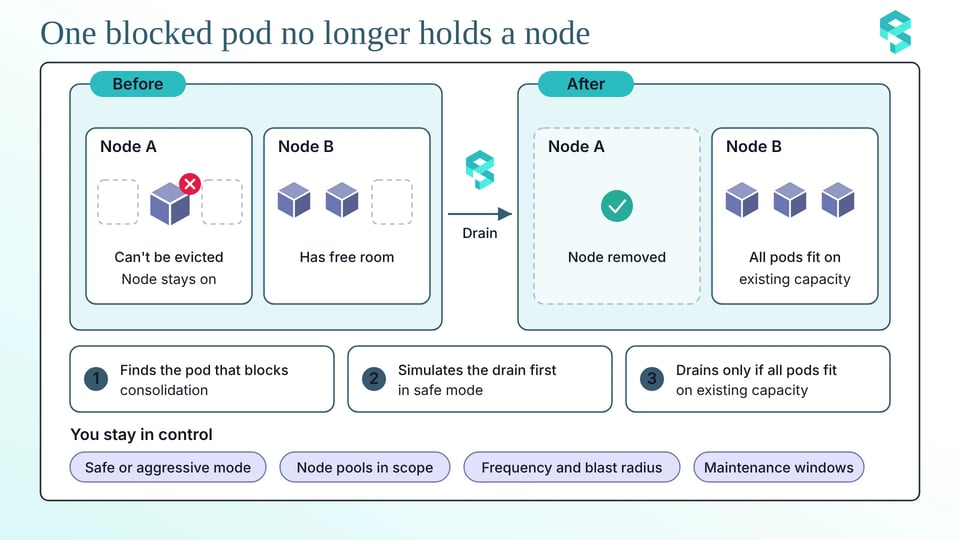
PerfectScale already shows which pods block consolidation, why they're blocking it, how to resolve it, and even how much idle capacity costs you. Now it can address those blockers automatically. You control how it works: choose safe or aggressive mode, select the node pools in scope, set the execution frequency and blast radius, and define maintenance windows. In safe mode, PerfectScale simulates the drain first and proceeds only if all evicted pods can fit on existing capacity.
HPA automation
HPA can keep more replicas running than a workload needs, scale too late to prevent resource pressure, or fail to reflect the application's actual load. These issues often go unnoticed as workloads change.
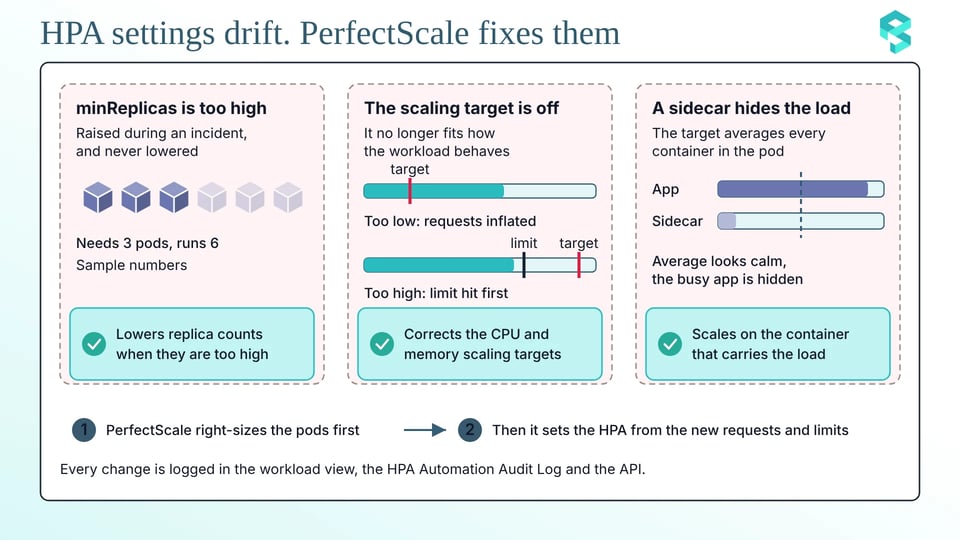
A few common reasons: The minimum replica count may be too high, for example, when minReplicas is raised during an incident and never lowered again. The scaling target may no longer fit the workload: set it too low, and pods may need larger resource requests than they actually use; set it too high, and containers can hit CPU limits or run out of memory before HPA scales out. Finally, a sidecar can mask the application's actual load, making a heavily loaded application container look less busy than it really is.
PerfectScale now detects and fixes these issues automatically. It lowers replica counts if they are too high, corrects CPU and memory scaling targets, and directs scaling decisions to the container that actually carries the load. Because scaling targets and pod resource requests depend on each other, PerfectScale tunes them together with vertical and node autoscaling, preventing one change from undoing the benefits of another. Every change is logged and visible in the workload view and through the API.
Immediate OOM reaction
Safety has always been a focal point for PerfectScale. We continue to add safeguards that help teams optimize infrastructure without putting workload reliability at risk.
When a workload runs out of memory, the common fix is to increase the memory limit on every replica “just to be safe.” It may prevent another crash, but it also adds resources you keep paying for long after the incident.
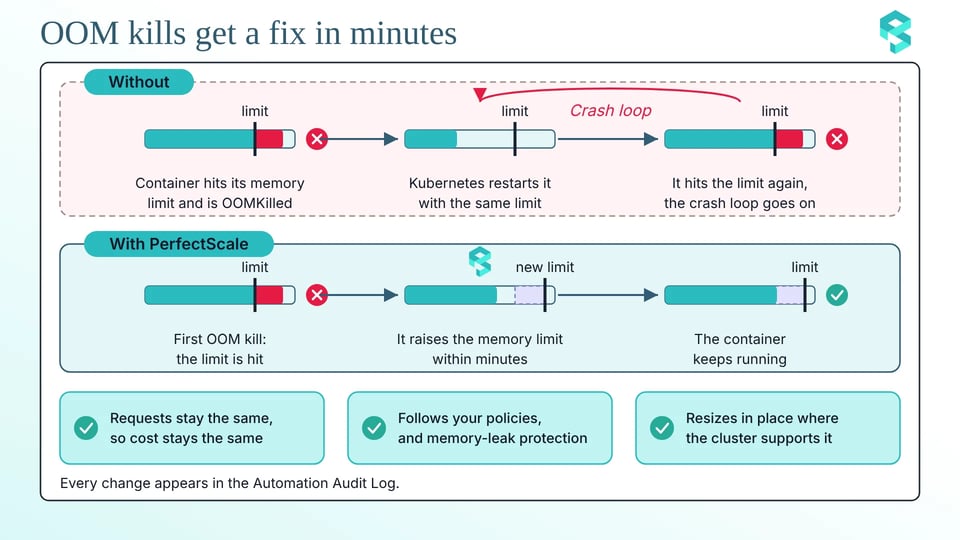
PerfectScale now reacts immediately to OOM events, quickly adjusting memory limits to reduce the risk of repeated crashes and keep workloads running reliably.
The bottom line
Together with pod rightsizing, these capabilities extend optimization across the entire Kubernetes stack, from workload resource requests and replica counts to node provisioning, consolidation, and utilization. PerfectScale keeps these layers aligned as your workloads and infrastructure change, so you cut costs without taking on reliability risk. It works with the tools you already use, without adding another component to your stack. We'll be at booth #131 at KubeCon NA, in Salt Lake City. Stop by to see it live, ask our engineers tough questions, and share your Kubernetes optimization challenges. We love a good Karpenter or HPA puzzle.

📅 Want dedicated time with our team? Book a meeting at the booth!
Not using PerfectScale yet? Start for free and see what's running in your clusters before the show.