
Your Kubernetes Node Pool Plan Was Stale Before You Saved It
A tactical guide for platform engineers on why static node planning breaks, and how continuous rightsizing closes the loop across pods and nodes.
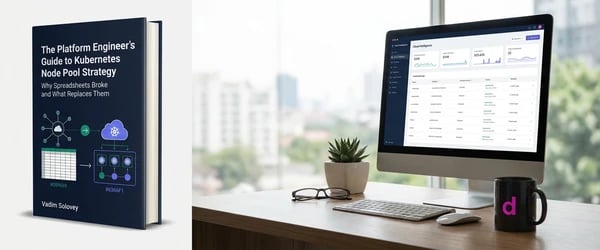
Pod requests drift, autoscalers reshape node counts, and spot interruptions swap instance families every hour. This guide walks through why manual node pool tracking fails under real Kubernetes behavior, and what a continuous optimization loop looks like in practice.
See 8 tips for rightsizing your Kubernetes cluster
Fill in a few details to get instant access.
Written By

Vadim Solovey, Founder
Founded DoiT in 2011 and have been here ever since — in every flavor of CTO, co-CEO, and now CEO. I started my career in 1999 building data centers before anyone called it "the cloud," and I've spent the two decades since trying to deliver on what the cloud was actually supposed to be. I still write code most weeks.
01
Why do node pool spreadsheets go stale?
Pod requests change with every deploy, and Karpenter or Cluster Autoscaler reshape node counts throughout the day. Any static plan is out of date within hours.
02
How do pod and node rightsizing connect?
Wrong pod requests force oversized nodes. Wrong node families cap workload performance. The guide shows why both decisions belong in a single optimization loop.
03
How do you apply changes without restarts?
PerfectScale analyzes workload behavior and node topology together, then applies rightsizing continuously without pod restarts or helm chart changes.
04
Who owns node pool decisions?
Accountability sits with the platform engineers running the workloads, not a central spreadsheet owner. The guide covers how to share visibility across SRE, dev, and finance.
05
How fast is time-to-first-recommendation?
Setup to first recommendation takes under 5 minutes across EKS, GKE, AKS, and self-managed clusters. No code changes required.
Frequently asked
questions
What is a Kubernetes node pool strategy?
A node pool strategy defines which instance types, sizes, and topology constraints your workloads run on. It also covers how those choices adjust as pod requests, autoscaler behavior, and traffic patterns change.
Why does manual node rightsizing fail in Kubernetes?
Pod requests, autoscaler decisions, and spot interruptions change faster than any spreadsheet can be updated. By the time a plan is reviewed, the underlying cluster state has already moved on.
What's the difference between node rightsizing and pod rightsizing?
Pod rightsizing adjusts CPU and memory requests for individual workloads. Node rightsizing selects the instance families and sizes that host those pods. Both decisions affect cost and performance, so they need to be solved together.
How is this different from VPA or a cost dashboard?
VPA restarts pods when it applies changes and doesn't consider node topology. Dashboards surface waste but leave the work to a human. PerfectScale runs continuous rightsizing across pods and nodes without restarts.
Which Kubernetes distributions does PerfectScale support?
PerfectScale works across EKS, GKE, AKS, and self-managed clusters. Installation doesn't require helm chart changes or code modifications, and first recommendations arrive in under 5 minutes.
Where can I learn more?
- Your Kubernetes node pool strategy was stale before you saved the file · Blog Posts
- EKS Pricing Components, Hidden Costs, and 6 Ways to Optimize · Blog Posts
- PerfectScale: Q3 2024 Releases Recap · Blog Posts
- Amazon EKS Cost Optimization Best Practices · Blog Posts