
PerfectScale
Horizontal vs Vertical scaling
Learn about the pros and cons of horizontal and vertical scaling to optimize your system's performance.
This page is also available in Deutsch, Español, Français, Italiano, 日本語, and Português.


About Marie Jaksman
Part growth marketer, part DevOps translator. Optimizing funnels and clusters with a healthy fear of wasted compute.
My personal pageVertical scaling (scaling up) means adding more power (CPU, RAM, storage) to an existing server, whereas horizontal scaling (scaling out) means adding more servers to distribute the workload. Vertical scaling is simpler but limited by hardware, while horizontal scaling offers near limitless capacity and fault tolerance but increases architectural complexity.
Vertical vs horizontal scaling are two primary methods used in the tech industry for enhancing system capacity. These strategies are essential for businesses to understand as they develop systems capable of coping with growing demands without losing performance efficiency. Vertical scaling involves adding more power to existing hardware (RAM, CPU, GPU, and other resources), while horizontal scaling means expanding the system by adding more machines or nodes.
Generally, horizontal scaling is employed to manage rising traffic or workload volumes, whereas vertical scaling is often utilized for tasks or applications that are resource-heavy and demand greater processing power.
Today the line between these two approaches is increasingly blurred. Cloud-native platforms now automate both patterns, and most modern architectures rely on a hybrid model that scales stateless services out while scaling stateful databases up. Recent Kubernetes releases even allow running workloads to be resized in place, without the disruptive restarts that once made vertical scaling impractical for production.
In this article, we will explore the differences between horizontal scaling and vertical scaling, discuss their respective advantages, and find out what the best solution is for your business.
Vertical scaling at a glance:
- How it works: Upgrades a single machine's specifications, such as swapping a 16GB RAM instance for a 64GB RAM instance.
- Pros: Simpler to manage with no need for load balancers, and data consistency is easy since everything resides on one machine.
- Cons: Hard physical limits, required downtime to perform upgrades, and a single point of failure.
- Best for: Monolithic applications, single-node databases, or workloads that are difficult to distribute across a network.
Horizontal scaling at a glance:
- How it works: Adds more identical machines to a cluster and uses a load balancer to distribute incoming traffic across them.
- Pros: Theoretically limitless scalability, high fault tolerance and resilience, and no downtime during upgrades.
- Cons: Higher initial cost, complex setup requiring load balancers, and challenging data synchronization and consistency.
- Best for: Modern web apps, microservices, and dynamic or unpredictable traffic spikes.
What is Horizontal Scaling?
Horizontal scaling, also known as "scaling out", involves adding more machines or nodes to a system to handle increased traffic or workload. In other words, instead of relying on a single powerful machine, horizontal scaling distributes the workload across multiple machines.
›› Explore what HPA is, how it works, the implementation of HPA, best practices, and limitations.
Benefits of Horizontal Scaling
One of the main benefits of horizontal scaling is its ability to provide high availability and fault tolerance. By distributing the workload across multiple machines, even if one machine fails or goes offline, the system can still function properly using the remaining machines.
Additionally, horizontal scaling allows for easy and cost-effective scalability, as new machines can be added incrementally when needed.
In cloud-native environments this elasticity is now largely automated. Auto-scaling groups and Kubernetes Horizontal Pod Autoscalers add capacity within seconds when traffic spikes and remove it when demand falls, so capacity closely tracks real usage. The trade-off is operational: teams must tune scaling thresholds and cost guardrails carefully, since poorly chosen rules can trigger runaway scaling and surprise bills.
Implementing Horizontal Scaling: Distributing Workload Across Multiple Systems
Let's dive deeper into the concept of horizontal scaling and explore its various aspects.
When it comes to horizontal scaling, the key idea is to distribute the workload across multiple machines. This distribution can be achieved through various techniques such as load balancing, sharding, or replication.
- Load balancing is a technique that evenly distributes incoming requests across multiple machines. It ensures that no single machine is overwhelmed with excessive traffic, thus improving the overall performance and responsiveness of the system. Load balancers can be implemented using hardware or software solutions, and they play a crucial role in horizontal scaling.
- Sharding is another technique used in horizontal scaling, particularly in distributed databases. It involves dividing the data into smaller subsets called shards and distributing them across multiple machines. Each machine is responsible for storing and processing a specific shard of data. This approach allows for parallel processing and improves the system's ability to handle large datasets and high traffic loads.
- Replication is yet another important aspect of horizontal scaling. It involves creating copies of data or services across multiple machines. These copies, also known as replicas, ensure that the system can continue to function even if one or more machines fail. Replication can be implemented at various levels, including database replication, file replication, or service replication.
In conclusion, horizontal scaling is a powerful technique that allows for the distribution of workload across multiple machines. It provides high availability, fault tolerance, and cost-effective scalability. Techniques such as load balancing, sharding, and replication play a crucial role in achieving horizontal scalability.
Now, let's learn about the concept of vertical scaling.
What is Vertical Scaling?
Vertical scaling, also known as "scaling up", involves increasing the resources of an individual machine to handle an increased workload. This typically involves upgrading the hardware components of a machine, such as its memory or processing power.
Benefits of Vertical Scaling
When it comes to vertical scaling, there are various ways to upgrade the hardware components of a machine.
- One common approach is to increase the memory capacity. This allows the machine to store and process larger amounts of data, which can be particularly useful for applications that require extensive data processing or analysis.
- Another aspect of vertical scaling involves upgrading the processing power of a machine. This can be done by replacing the existing processor with a more powerful one or by adding additional processors to the machine. With increased processing power, the machine can handle more complex tasks and calculations, resulting in improved performance and faster response times.
- In addition to memory and processing power, other hardware components can also be upgraded during vertical scaling. For example, upgrading the storage capacity of a machine can provide more space for storing data and files. This can be beneficial for applications that generate large amounts of data or require extensive storage capabilities.
Vertical scaling is often employed in scenarios where the workload of a single machine increases gradually over time. By upgrading the resources of the machine, it can continue to handle the growing workload without the need for additional machines or complex configurations.
Limitations of Vertical Scaling
However, vertical scaling does have its limitations. There is a maximum threshold to how much a machine can be upgraded before it reaches its hardware limitations. At this point, further vertical scaling becomes impractical or even impossible.
A common signal to move beyond vertical scaling is sustained high utilization. When CPU, memory, or I/O consistently sit near capacity, keeping resource usage below roughly 70 to 80 percent preserves headroom for spikes, and it is often the point at which teams begin scaling out for redundancy and cost control.
In such cases, alternative scaling strategies, such as horizontal scaling, may need to be considered.
In conclusion, vertical scaling is a method of increasing the resources of an individual machine to handle an increased workload. It involves upgrading the hardware components, such as memory and processing power, to improve performance and efficiency.
>> Want to automate your horistontal and vertical scaling? Learn how to implement autoscaling for optimal K8s performance.
In-Place Scaling: Blurring the Line Between Up and Out
One of the most significant recent shifts in scaling is the ability to resize a running workload without restarting it. Historically, vertical scaling required downtime because upgrading a machine or pod meant stopping it, applying the change, and starting it again. In containerized environments this restart made automated vertical scaling risky for stateful and long-running services.
In Kubernetes, in-place pod resizing has now graduated to a stable feature, allowing CPU and memory to be adjusted on live pods without eviction. The Vertical Pod Autoscaler builds on this with an update mode that applies its recommendations in place, so pods can be right-sized continuously throughout the day instead of only at deployment time. This removes the long-standing chicken-and-egg problem where the autoscaler knew the correct resource values but could only apply them by disrupting the workload.
The practical impact is that vertical scaling is no longer synonymous with downtime. Workloads can request extra CPU during startup and scale back down afterward, or grow and shrink with demand while staying online. Combined with horizontal autoscaling, this gives teams a smoother path to a hybrid model, vertically right-sizing individual nodes and then horizontally adding more of those optimally sized nodes.
Horizontal vs Vertical scaling:
Now that we have a clear understanding of the concepts of horizontal scaling vs. vertical scaling, let's build a comprehensive comparison between the two scaling strategies.
| Horizontal Scaling | Vertical Scaling | |
|---|---|---|
| Definition | Adding more machines to a system to distribute the load. | Adding more power (CPU, RAM) to an existing machine. |
| Scalability | Can scale out indefinitely, limited by software capability. | Limited by the maximum capacity of a single machine. |
| Cost | Initially high due to the need for more hardware, but more cost-effective in the long run. | Lower initial cost, but can become expensive due to high-end hardware requirements. |
| Complexity | More complex due to distributed computing challenges. | Simpler as it involves upgrading existing components. |
| Performance | Good for handling large volumes of transactions or data. | Good for intensive processing tasks. |
| Downtime | Often scalable without downtime. | May require downtime for hardware upgrades. |
| Resource Utilization | Efficient in distributing workloads. | Can lead to underutilization or overutilization of resources. |
| Flexibility | High flexibility in handling variable loads. | Less flexible, relies on the capacity of a single machine. |
| Suitability | Ideal for web-based, distributed applications. | Suitable for applications with intensive processing needs. |
| Examples | Cassandra, MongoDB, Google Cloud Spanner. | MySQL and Amazon RDS. |
Understanding the Differences between Horizontal Scaling and Vertical Scaling
Horizontal scaling is well-suited for distributed systems that can take advantage of parallel processing. It is particularly effective for applications that can be easily divided into smaller independent tasks that can be processed concurrently.
Examples of such applications include web servers, content delivery networks, and distributed databases.
For example, in a web server environment, horizontal scaling allows for the distribution of incoming requests across multiple servers, enabling better performance and fault tolerance. Each server can handle a portion of the workload, resulting in faster response times and increased availability.
Sustainability has become part of these scaling decisions too. Carbon-aware autoscaling adjusts resource allocation based on the carbon intensity of different regions and time periods, automatically shifting flexible workloads toward data centers running on cleaner energy. Major cloud providers now offer this capability, and it can meaningfully reduce emissions with little impact on application performance.
On the other hand, vertical scaling is beneficial when the workload requires access to a large amount of shared resources, such as a centralized database. It is useful for applications that cannot be easily partitioned and require the entire dataset to be accessible on a single machine. Examples of such applications include traditional SQL databases and certain enterprise applications.
For instance, in a centralized database scenario, vertical scaling involves increasing the resources of a single machine, such as adding more memory or upgrading the CPU. This allows the database to handle larger datasets and complex queries without the need for data partitioning or distribution.
Horizontal vs Vertical Scaling: Making the Right Choice
Deciding whether to use horizontal scaling or vertical scaling depends on various factors, such as the nature of the workload, cost considerations, and the specific requirements of the system.
Let's take a closer look at the differences between these two approaches.
Firstly, the nature of the workload and the specific requirements of the system should be taken into account. For horizontal scaling, technologies such as load balancers, containerization, and microservices architectures can be beneficial.
For example, in a microservices architecture, horizontal scaling can be achieved by deploying multiple instances of individual microservices and using a load balancer to distribute incoming requests. This allows for better fault tolerance and scalability, as each microservice can be scaled independently.
For vertical scaling, technologies such as virtualization and cloud-based services can provide the necessary resources to enhance the performance of a single machine. It is essential to evaluate the cost implications, maintenance overhead, and compatibility with existing infrastructure when choosing the right technology for scaling.
Cost strategy has also matured alongside these choices. Mature teams increasingly combine three capacity tiers: reserved instances for predictable baseline load, on-demand capacity for the variable band up to peak, and spot or preemptible instances for fault-tolerant work. Pairing horizontal auto-scaling with this tiered purchasing consistently reduces compute costs compared with statically provisioning vertical infrastructure sized for peak demand.
For instance, in a cloud-based environment, vertical scaling can be achieved by utilizing the scalability features provided by the cloud provider, such as auto-scaling groups or instance resizing. This allows for dynamic resource allocation based on the workload, ensuring optimal performance and cost efficiency.
In practice, modern architectures typically use a hybrid approach rather than choosing one method exclusively. For example, an organization might horizontally scale its stateless web servers to handle thousands of concurrent users, while vertically scaling its central database to maintain high-performance I/O operations without dealing with complex distributed database transactions.
In conclusion, the choice between horizontal and vertical scaling depends on the specific requirements of the system, the nature of the workload, and the desired level of scalability. Both approaches have their own advantages and limitations, and it is important to carefully evaluate these factors before making a decision. Ultimately, a well-designed scalable system can ensure optimal performance and accommodate future growth effectively.
Scale automatically with PerfectScale by DoiT
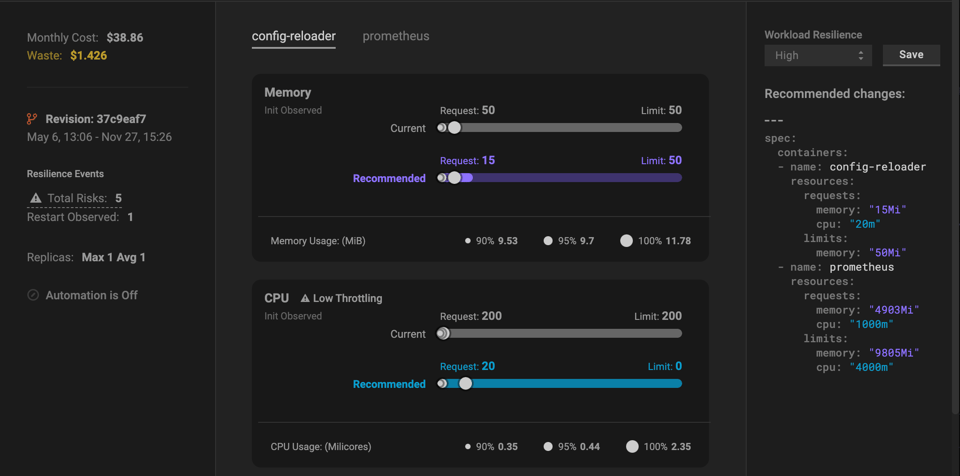
PerfectScale offers a comprehensive solution for organizations of all sizes to reduce cloud costs without sacrificing performance. Utilizing advanced algorithms and machine learning, it ensures services are optimally resourced to balance demand and cost. PerfectScale simplifies Kubernetes cost optimization by automatically right-sizing and scaling resources, adapting continuously to dynamic environments. This reduces waste and enhances system stability.
By handling Kubernetes cost optimization, PerfectScale frees DevOps, Platform, SRE, and FinOps teams to concentrate on more strategic projects. It assures ongoing optimal scaling of your K8s environment, resulting in lower cloud expenses, fewer SLA/SLO breaches, and reduced outages. Users experience enhanced reliability and stability.
Easy to implement, PerfectScale begins delivering immediate results. Sign up or Book a demo with the PerfectScale team today!